Title: Translation
Text by Harvest Capital, Song Xiangqian

The Matthew Effect, originating from the New Testament's Gospel of Matthew, is a parable that states: "For to everyone who has, more will be given, and he will have abundance; but from him who does not have, even what he has will be taken away." In the late Spring and Autumn period around 571 BCE, Laozi, in the Dao De Jing, also expressed a similar idea: "The way of heaven reduces excess and supplements deficiency; the way of man is not so, it reduces deficiency to provide for excess." This concept predates the Matthew Effect by several centuries. The divergence of prehistoric civilizations in the East and West, along with millennia of debate on human nature, reflects significant differences in human values and perspectives in today's real world. While everyone holds an ideal country in their hearts, the reality is akin to the Rashomon Gate, filled with the banality of evil that seems to determine our destiny through faith, circumstances, and chance.
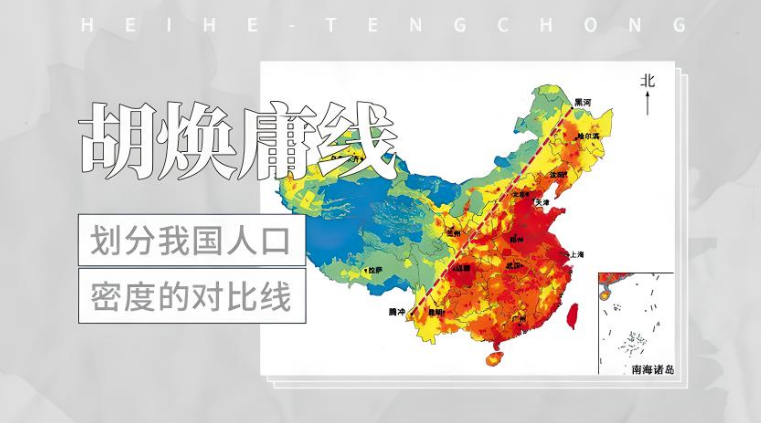
In 1935, Chinese geographer Mr. Hu Huanyong drew a line at a 45-degree angle on the map, stretching from Heihe in the northeast to Tengchong in the southwest, traversing the entire China. This Hu Huanyong Line serves not only as a natural geographical and historical-cultural boundary but also miraculously coincides with China's 400mm annual precipitation line. More importantly, it has witnessed significant historical changes in the economic and cultural development between the eastern and western regions over the past century. While the eastern side of the Hu Huanyong Line constitutes only 43.8% of the land area, it holds over 94.1% of the population and over 90% of the GDP. Such geographical dividing lines represent disparities in population and economic distribution and act as boundaries between prosperity and desolation. In this sense, this line "divides" all countries in the world into two parts.
Through the prism of the magical three years, in addition to the objective existence of the Hu Huanyong Line in real life, there is also a clear "Hu Huanyong Line" in the hearts and humanity behind society. While physical boundaries may not be frightening, the psychological "Hu Huanyong Line" is the river of the heart and the watershed of humanity. Many people are unable to peacefully cross this river throughout their lives, nor can they cross this ridge, finding joyous reconciliation with themselves on the high ground of human brilliance. It is as if they become fallen angels, forever losing the blue sky.
In that famous fairy tale, the innocence of a little boy saved the absurdity of time, but the collective unconscious banality of evil caused conscience and common sense to completely collapse. Hearts are shrouded in dust, the world becomes dim, and science and wisdom gradually lose their brilliance amid the banality of evil. Time sheds its beautiful exterior, leaving only the torment and helplessness of the years. Innocence cannot achieve redemption in the real world, and the ideal utopia is unlikely to descend into the absurd reality. Ignorance, lies, and fear have left no place for common sense and conscience, let alone science and wisdom. The century-long delay of Mr. Virtue and Mr. Sage accuses the banality of evil in the world, marking an exaggerated scale of numbness. Behind every unfortunate lament, there are countless expressions of resentment, and behind each expression of resentment, there is even more hatred for inaction. Every instance of life falling short is accompanied by countless drifting with the current. If banality of evil is kidnapped by power and injected with a bit of so-called moral force, it becomes nearly unstoppable self-destruction. History is always surprisingly similar; Léon's clear definition and Mr. Eagle's untrustworthiness finally taught us that the true path in this world is full of vicissitudes. The actions of the big goose and the cannons of Palestine have made everyone self-aware, and world peace has shattered, revealing that peace and happiness are so distant.

Everyone has the right to converse with God, and each heart abides by its own joyful and serene Buddha. Spiritual reconciliation, a harmonious and peaceful existence, perfectly explains the beauty of the secular world and the radiance of human nature. This also elucidates the basic logic of what it means to be human and the essence of society. From the Tang and Song dynasties, through the Ming and Qing dynasties, to the Republic of China, as long as there was an era that respected human nature, valued livelihood, and respected humanistic spirit, Chinese civilization shone brilliantly. Relaxed social environments are linked to a relaxed society, and political ideologies and social environments that are harmonious and relaxed with livelihoods are interconnected. Charlie Chaplin once said, "Time is a great author; she can write the future ending." I wish for a peaceful and splendid ending.
The taste of life, comforting the hearts of ordinary people, is the greatest beauty in the world. The greatest happiness in human life lies in the trivial daily routines of the common people. The reform and opening-up led by Elder Xiaoping, rather than being a victory for ordinary or civilian politics, is more a return of humanity and the manifestation of human values after profound reflection. The great historical significance of reform and opening-up is comparable to the Renaissance movement in Western society. After groping through centuries of darkness in the Middle Ages, it reawakened conscience, revived humanity, respected common sense, and enlightened modern science and democracy, laying the foundation for the modern civilization of human society.
Hegel once said, "A nation has a group of people who look up at the stars, and thus they have hope." Xiaoping was full of deep concern for the survival and real destiny of the common people. At the age of seventy, despite almost being imprisoned and living in a humble abode, he still took care of disabled children, bathed them, and enjoyed the joy of grandchildren around his knees. A great politician is first and foremost a normal father. Behind the mountain-like love of a father is often the deep affection and silent companionship of an ordinary person. Xiaoping has a profound empathy for the lives of ordinary people. In Xiaoping's view, modern individuals possess subjective consciousness, and the basic features of human subjective consciousness are liberated thinking and a pragmatic approach. Every person has the freedom to be free from poverty and fear. This aligns with Locke's theory of natural freedom. In contrast to free individuals, the basic characteristics of "mechanical beings," "dogmatic beings," and "tool beings" opposing subjective freedom are blind obedience, rigid thinking, and lack of humanity. The respect and adherence to humanism and human values are important cornerstones of Deng Xiaoping's humanistic thinking and political philosophy. Xiaoping advocates that, whether in revolution or construction, the highest standards must be based on the interests, rights, and values affirmed by the people. Xiaoping did not abstractly discuss the issues of individuals and human nature. In his humanistic value philosophy, the greatest pursuit is to let the people live a good life. This has been his consistent advocacy. The practice of millions of people is the only criterion for testing truth. The pursuit of liberation and freedom for individuals is the ultimate goal of Xiaoping's humanistic value pursuit. In a sense, it is the anchor for the peace of the hearts of the people in that era.