

Milestones
Annual financial thought leader Song Xiangqian: Technology and consumption are not an either-or choice.
Date: 2024-02-02Views:
via:丨 First Financial
Speaker Songxiangqian
ecently, the First Financial 2023 "Annual Financial Thought Leaders" Summit was held, and Mr. Song Xiangqian, Founder and Chairman of Harvest Capital, was honored with the title of "Financial Thought Leader of the Year 2023.
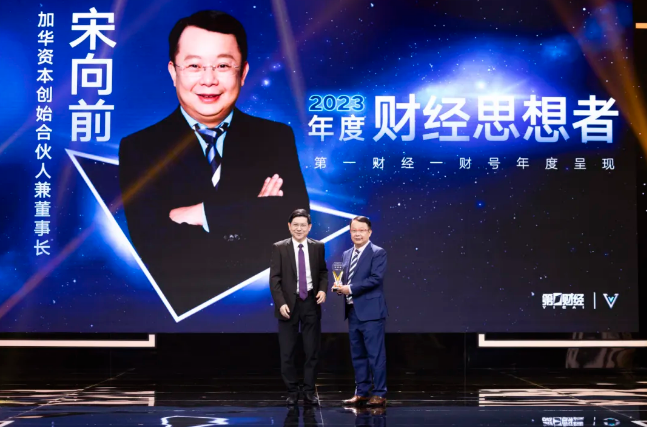
Translation:
At the recent First Financial 2023 "Annual Financial Thought Leaders" Summit, Mr. Song Xiangqian, Founder and Chairman of Harvest Capital, delivered a keynote speech titled "Technology and Consumption: Not a Binary Choice." Here is the content of his speech:
Hello everyone, I am Song Xiangqian, Founder and Chairman of Harvest Capital.
In the past few years, I've been anxious, much like the "tunnel effect": groping in the dark before seeing the light. This year (2023), I see the light, and that light is "high-quality growth."
I believe a crucial aspect of "high-quality growth" is the shift from quantity to quality. We have previously achieved economic miracles, but after the release of such miracles, we gradually entered a period of stable growth. Therefore, our growth should no longer rely on quantity; more importantly, it should focus on quality. In the face of the pains of economic transformation, we can no longer simply rely on "quantity control," such as loosening monetary policy, powerful fiscal policies, and issuing more national bonds. In the future, we should diversify debts and deleverage, relying on "quality control." This includes optimizing resource allocation, adjusting industrial structures, allocating resources to more efficient and technologically strong enterprises, allowing them to solve employment issues and create a better life for the people. This requires us to adhere to the development of a market economy, create a better business environment, and establish good legal safeguards.
Furthermore, 2023 has brought many positive developments, such as promoting the return of Sino-U.S. relations to a healthy and stable development track. Cooperation is more important than competition, and everyone is aware of the importance of cooperation, even if it is maintained at a minimum level. Significant changes happen this way, and I hope more positive events like this will continue, making peaceful development the mainstream in the world.
Today's China is closely related to the macroeconomy and the fate of enterprises. Chinese entrepreneurs are relatively hardworking on a global scale, having to excel in both micro-level business operations and sharp analysis and judgment of the macroeconomic situation and development trends. Especially today, China's overall goals for economic and social development prioritize national security and fairness. The entire society is indeed facing a period of transformative change that occurs once in a century, and I believe this period of transformation may last 10-20 years.
The first point I want to discuss today is that the focus of "Double Innovation" will also shift from "quantity" to "quality." The "Double Innovation" movement of "mass entrepreneurship and innovation" is a very good policy direction that I highly approve of.
However, objectively speaking, it has faced significant challenges in the past few years. Now is a low point for entrepreneurship. Economic growth is slowing down, structures are transforming, and society is undergoing a transformative change that occurs once in a century. But at any time, there are no industries that cannot be done well; there are only companies that cannot do well. Even in declining industries, there are rising enterprises. The era may not have entrepreneurs, but it should have entrepreneurs for the era. In the business world, truly successful enterprises are still a minority. The formation of business talent and wisdom takes time; it's a process of sifting through the sands. "Double Innovation" will become an elite movement rather than a mass movement. However, the mission of entrepreneurs still exists. In developed countries such as Germany, Japan, and France, small and medium-sized enterprises support the national economy. In China, they account for nearly 50% of GDP. Small and medium-sized entrepreneurs, individual businesses, and self-employed small enterprises will be the active market of the future Chinese economy, absorbing a massive amount of employment, creating a substantial amount of tax revenue, and acting as stabilizers and ballasts for economic development and social stability. They are also the driving force for the healthy, orderly, and high-quality development of the Chinese economy. Long-term stable development of any economy relies not only on towering trees but also on small flowers and grasses with tenacious vitality, as confirmed by the development history of modern business and the situation in developed economies.
In the future, solving the employment of a massive workforce cannot solely rely on large enterprises. Therefore, "Double Innovation" is a subject of the times. The focus of this subject is that the direction of "Double Innovation" is correct. The future challenge is how to carry out high-quality "Double Innovation," how to truly help small and medium-sized enterprises, and even individual businesses, to settle down, be happy in their careers, establish, thrive, succeed, and innovate.
Translation:
Firstly, we need to activate the vitality of micro subjects. As of today, China's economic development has reached the second position in terms of GDP globally and the third position in terms of economic scale. The era of large waters and big fish has completely passed, making entrepreneurship more challenging, and competition more intense. Especially, many entrepreneurs simply focus on optimizing product functionalities, improving consumer experiences, or releasing emotional values, making the entry barrier for such entrepreneurship low, lacking structural competitive advantages, without strong foundations, and susceptible to being cleared out during economic fluctuations and market competitions. This has been a dilemma faced by China's "Double Innovation" movement over the past 7-8 years.
The first batch of entrepreneurs participating in the "mass entrepreneurship, and innovation" movement in China has left a vivid mark. They share some common characteristics - having received excellent education, possessing strong entrepreneurial enthusiasm, and mastering business knowledge, information, and the talent for business. However, objectively speaking, the quantity of their involvement in entrepreneurship outweighs the quality. Taking consumption as an example, many companies rely on traffic for entrepreneurship, but this is just a method of commercial realization that fundamentally depends on channels.
The core competitiveness of business still requires comprehensive capabilities, encompassing everything from production, research and development, operations, marketing to channels. Bluntly using traffic, relying on attention economy, capturing market realization dividends from human weaknesses, and hastily using the long board for entrepreneurship is at best a cash flow business, far from being a genuine entrepreneurial venture. Entrepreneurs should also remember that time is the scale for measuring the value of a business, and profit is the by-product of doing the right things. Only by making gradual progress day by day can true success be achieved.
The second point I want to discuss is that without consumption, technological development will become water without a source. Starting from this year (2023), simple factor dividends such as population dividends have already disappeared. The importance of institutional dividends in production factors has begun to highlight. China has state-owned and private capital, domestic and foreign capital distinctions. We should focus on creating a neutral competitive environment and a unified large market. We have always emphasized the construction of a unified large market. As long as the market competition is neutral, the competitive environment is fair and legal, the market can release tremendous potential and elasticity. We need to clearly recognize that a market economy does not come from support; it must develop and grow in competition.
Since the reform and opening up in 1978, our core competitiveness has been the release of institutional dividends, and more importantly, the loosening of society, livelihoods, the economy, and the business talent and capabilities of entrepreneurs, leading to nearly thirty years of economic resurgence and rapid growth.
The release of "institutional dividends" will take time. For us, this is a new thing, and our cognitive abilities are limited. In the construction of a market economy, we are still beginners. We have only been part of the WTO for 22 years, and the restoration of the college entrance examination is only more than 40 years old. After the release of "institutional dividends," it will profoundly and long-lastingly affect the venture capital industry. The main contradiction in the new era of society is the contradiction between the increasing needs of the people for a better life and the imbalances and inadequacies in development. China's economic and social development will undoubtedly revolve around this theme.
Emphasizing technological progress, seeking productivity from technological progress, and increasing overall labor productivity and potential growth rate.
China is a country with a population of 1.4 billion. The common people have a desire for a better life. Therefore, we must develop the consumer service industry, and society must transition from a production-oriented society to a consumption-oriented society. The era of large waters and big fish has passed, and we have entered the era of stock competition. What will be the focus of economic development next? Personally, I believe it will ultimately rely on the consumer service industry. In the third quarter of this year (2023), the contribution of final consumption expenditure to economic growth was as high as 94.8%.
Although there are some challenges for consumer companies to go public at present, difficulties are only temporary. The consumer industry provides good products and services for the common people, absorbs a massive amount of employment, and creates a substantial amount of tax revenue. This not only aligns with the direction of social development advocated by the country but also effectively solves the main contradictions in social development.
In the short term, the issuance resources of the capital market are limited, and it is reasonable to support important technology companies. However, in the long run, support and development are also needed for the consumer and service industries. We cannot pit consumption against technology and make it a "binary choice." On the contrary, technology and the consumer industry, as the pillars and supporting industries of the national economy, should and must develop well. Policies of so-called "industry discrimination" should not be implemented to maintain development.
Consumption and technology are two sides of the same coin in the development of the socio-economic, and they are also the two most important development elements and driving forces in the national economy: one is technological progress, and the other is consumption support. Consumption provides technological companies with application scenarios. For example, most AI companies are in the to-G business, but what sustains their survival is the consumer market. Consumer companies are customers of technology companies, they are the first party. Without consumer scenarios, the decoupling of technology companies and consumer companies will result in a single revenue structure for technology companies, limited profits, and development constraints.
Why do Huawei phones sell so well? In addition to technological progress, more importantly, China has a vast consumer population. It is the support of the consumer electronics industry for continuous technological iteration and progress, with a huge consumer market, that has led to the rise of Huawei. Large American companies like Google, Apple, and Tesla are fundamentally consumer companies as well. All technology is ultimately for application, and we must prioritize people and consumers.
Therefore, consumption and technology are not in opposition; discrimination should be avoided, and encouragement of a binary choice is inappropriate. Instead, the two should develop in coordination with each other.
Translation:
Consumption creates employment and solves people's livelihood problems. Technology represents efficiency improvement, but it cannot solve mass employment (population). Developing the consumer service industry, absorbing massive employment, creating substantial tax revenue, the government will also have more financial resources to support technological development and progress. Without consumption, technology has no source of fresh water, and this fresh water is created by the consumer service industry. Consumer companies also have the equal right to use the capital market to continue growing stronger. China needs its own Coca-Cola, its own McDonald's, its own KFC, its own Apple, and its own Tesla. Today, companies like Huawei, Xiaomi, and NIO are examples of the strength of consumer companies competing globally.
Kant once said, "Man is the end." Technology is not the end; technology is a means and a tool, and the welfare of people is the end. Consumption and technology should not be set in opposition; the market should not be given a "binary choice." Discriminating against consumption is, in fact, hindering technology because technology will lose its market.
So today, what we are talking about is: technology is only a tool and a means; the welfare of people is the end.
Harvest Capital has been established for 16 years, experiencing several cycles and so-called eras of dividends and opportunities. We have always invested in the "essential needs + high-frequency + livelihood" industries, especially in consumer infrastructure.
From the current social contradictions, the basic livelihood needs of the common people have not been fully and effectively satisfied. We firmly believe in one thing: the development model of developed economies will ultimately shift from production-oriented to consumption-oriented. In the environment of high-quality development of the consumer service industry, we seek the greatest era dividends.
But our size and structure determine that we face greater challenges. We have entered the era of "stock game," and everyone will tighten their purse strings. The trend of consumption-driven will be a long-term issue. The vitality of market entities, stability of employment, and the continuous effective growth of per capita disposable income are the top priorities.
The mainstream trend of consumption should not only focus on Beijing, Shanghai, and Guangzhou. The 400 million middle-income group and the 900 million livelihood market are the real large markets. Providing good products that satisfy the essential needs of livelihood for ordinary people is the mainstream. The actual per capita purchasing power of the middle class is not high. They have mortgages, car loans, and possibly consumer loans. In fact, they are the "soft class" or "soft middle class." Regardless of economic fluctuations, the impact on "essential needs + high-frequency + livelihood" will be minimal. We need to grasp the greatest common divisor. We have such a huge demand for employment, so many small and medium-sized enterprises, and such a massive demand that has not been fully met. The consumer track is broad enough, the cycle is long enough, it is a typical long slope with thick snow track. We can inject our hearts and leave the rest to time, do things correctly, and do the right things.
In the current environment, entrepreneurs may still face opportunities and challenges. Entrepreneurs need to maintain the ability to learn for a lifetime, see the future, and plan and act accordingly. The future is an era where good people do business, "for business from virtue, the great way is simple." A good company often cannot do without the guidance of the correct values. China will enter an era of truly "good quality and low price," especially behind "good quality" products is the integrity of entrepreneurs.
Although the road ahead is long, with joint efforts, China's economic and social development will surely achieve the achievements it deserves. "Do not fear the floating clouds obscuring the eyes" and "let the wind blow from all directions!"
Related information