

Milestones
China, the Holy Grail of macroeconomics
Date: 2022-07-04Views:
Written By Song Xiangqian (Alan Song)

"A person has two selves, one awake in darkness, and one asleep in the light." - Kahlil Gibran
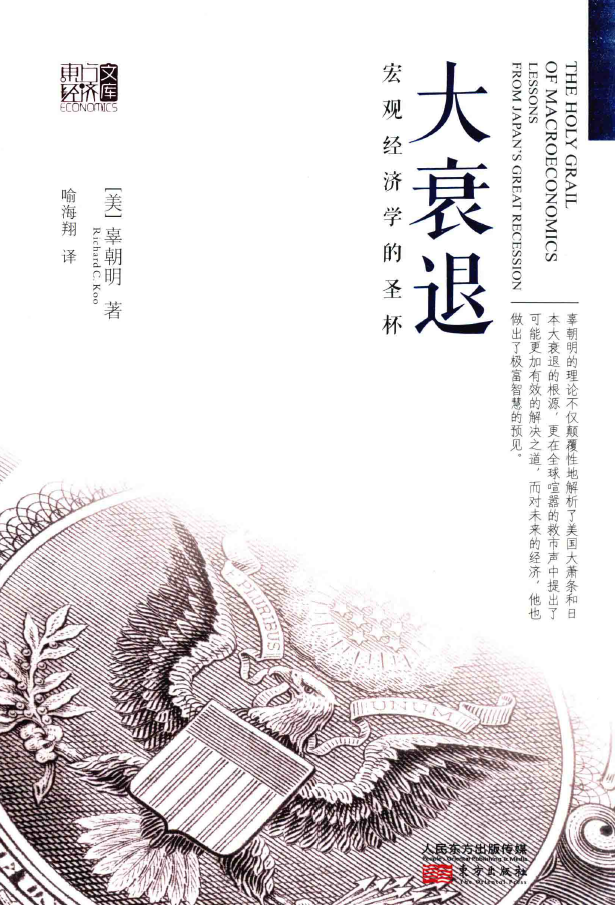
Former Federal Reserve Chairman Ben Bernanke once said: "Whoever can successfully explain economic recessions and the Great Depression will have successfully grasped the 'Holy Grail' of macroeconomic research." In his work "The Great Recession of Balance Sheets," Gu Chaoming successfully explains the challenges faced by Japanese residents and businesses in the period from 1995 to 2015, following the burst of the asset bubble. This includes debt reduction, deleveraging leading to a liquidity trap, and the dangers of deflation and recession. Starting from Japan's unique national and cultural context, his research explains the causes and characteristics of the recession during Japan's Heisei era. His research achievements come close to grasping the "Holy Grail" of macroeconomic research.
However, personally, I believe that the theory that can truly grasp the "Holy Grail" of macroeconomic research will inevitably emerge in China. Our dualistic economic development model, long-term leap-forward development trend, and the economic growth pattern formed through the interaction of planning and the market provide macroeconomists with the best research opportunities and the most fertile soil. In the historical journey of China's transition to a modernized and powerful nation, we are bound to explain all of this and provide growth dynamics and theoretical basis for the political, economic, and social development of human society. Perhaps, this discovery is more fascinating than Keynesianism and Coase's Law. The world may kiss me with pain, but I will respond with a song, embracing a broad perspective to achieve gradual accumulation and ultimate success.
From 1948 to 2018, over the past 70 years, we have experienced a cyclical economic crisis every decade, either endogenous or exogenous. The main manifestations include an economic recession and high inflation caused by an uncontrollable fiscal deficit, leading to both central and local fiscal deficits. Whether it was the failure of the gold yuan reform in the Republican era in 1948, the "Great Leap Forward" and the "Three Red Banners" in 1958, the substantial bankruptcy of central finance and the "up to the mountains and down to the countryside" movement in 1968, the active and passive initiation of reform and opening up after the "Second Leap Forward" in 1978, the fiscal deficit crisis in 1988 causing vicious inflation, panic buying, and a profound memory of the 28% subsidized interest rate, the Southeast Asian and U.S. financial crises in 1998 and 2008 causing an externally imbalanced economy leading to waves of unemployment and a major recession, and later the quantitative easing to rescue the market and the long-term stagflation and recession we have faced since 2018. The stubbornness of the "decade itch" of China's economic scale decline has left the world with a good research topic. Thoroughly summarizing the reasons for each downturn in China, analyzing the fiscal and taxation system, the level of national modernization management, especially the decisive role of modern fiscal and taxation system construction in enhancing China's economic and social governance level, understanding the main contradictions, is truly grasping the "Holy Grail" of macroeconomic research in China. Deep understanding of the Chinese economy is because what is truly effective in China today is "the situation is stronger than the individual." Many changes come from the power of turning points and the prisoner's dilemma of having to do things. Beethoven once said, "Adversity is the teacher of life, through adversity, we move towards joy."
Common sense, principles, conscience, and justice will not be absent, but they always come late. Therefore, patience becomes especially important, and reality requires everyone to empathize with the times and get involved. In rural China, practice the study of the relationship between mountains, rivers, and family, and integrate the homeland into one. Such long-termism may be a kind of ideology, not just a proposition. Ideals may become reality. Being optimistic about China is definitely a long-term perspective. Short-term endurance of pain and torture is inevitable. Pessimism and disappointment will hover and pervade in the short term. Breaking out of this psychological and cognitive pattern, interpreting the present and future with a broad view of history, may truly break through the cyclical theory of the rise and fall of great powers. Standing firmly on a long-term perspective is the true prosperity and strength of the country, the true faith of the people, the true strength of the country, and the true hope of the nation.

Related information