

Milestones
Who is Misunderstanding Internal Circulation? Finding Balance in the Game of Internal and External Economy | Alan's View
Date: 2022-03-19Views:
Written By Song Xiangqian (Alan Song) CEO of Harvest Capital
Internal circulation, anti-monopoly, internal integration, lying flat – these are the keywords of contemporary China. However, it's worth reflecting, do these keywords really touch upon the key aspects of the current domestic and international situation?
Everyone, to varying degrees, can feel that the world is different now. The past cannot be entirely blamed, and the magical year of 2021, with all its pain, has warned us – the battle China is fighting goes beyond combating the pandemic and economic recovery; it involves the lives of ordinary individuals, the inch of land for the citizens.
Every point of starlight in the lights of thousands of households is worth the protection of thousands of troops.
On the other hand, we also see the continuous influx of short videos, and the joy of live-streamed sales flooding out the painful contemplation and determination.
This is a fantastical metaphor. In the end, which one is the true contemporary China – the prosperity and happiness in the videos, or the rampant challenges in reality?
We need to carefully unravel and see what is haze and what is dawn.
One of my students, who has been an entrepreneur for many years, said his father is most grateful to Mr. Xiaoping. If it weren't for the story of that spring over forty years ago, their family might have spent their whole lives tending to a piece of yellow earth, with no place to strive.
Some people ask me why I chose China in the 1980s as the backdrop for the Super Wen and Friends, an investment of mine. I say, because in that era, all of China was immersed in a certain consensus. The entire society has never shared a moment of memory under such a grand narrative background.
Thanks to Mr. Xiaoping, he gave the people of China at that time a vast field of hope with no visible boundaries.

01
Let's first talk about the concept of "internal circulation." In fact, it's not a new concept; it's just a new term for Keynesianism in the current economic landscape.
Regardless of whom you are trading goods with, the essence of the commodity economy is exchange. Whether you are paying for vegetables at the market or trading commodities, the difference lies in whom you are buying from, how much you are paying, and how much you are buying.
In a self-sufficient agrarian society, exchanges occurred within a small community. For example, if your neighbor grew potatoes, you exchanged your vegetables for them. What about growing your potatoes and vegetables? Does that mean you don't need to exchange? No, you are using the harvest of autumn to exchange for the planting of spring because commodity exchange can span periods.
Understanding the nature of exchange in a commodity economy, we know that "internal circulation" is not the simplistic "let's be self-sufficient and not do business with foreign countries," as portrayed in the public discourse. It's not a multiple-choice question between option A or B; instead, it's a more complex and nuanced essay question that requires careful planning and discussion.
Looking back at the process of globalization, it was largely led by the United States. Silicon Valley, Wall Street, and Hollywood are the three gifts of American civilization to the world and the major beneficiaries of the globalization process within the United States.
Meanwhile, China played a low-profile but beneficial role. Leveraging globalization, we exported a significant amount of production factors to the world and attracted global resources into our market with the massive scale of our 1.4 billion population, practicing strategic restraint during the past forty years of reform and opening-up.
At the edge of the cliff of a raging pandemic, the United States realized that it wasn't the primary beneficiary in its own-led globalization movement. Ironically, Trump represented the demands of those on the margins of globalization within the United States. The resulting shift towards deglobalization has become one of the most discussed topics since the pandemic, including discussions about China's economic strategy of internal circulation.

So how is "internal circulation" precisely articulated?
—"Gradually forming a new development pattern with domestic circulation as the mainstay and domestic and international circulations reinforcing each other."
Undeniably, the current occurrence of internal circulation is driven not only by the trend of global internalization stimulated by the pandemic but also by China, as the second-largest economy, seeking a Nash equilibrium in the redistribution of internal and external development weights.
Internal economic driving force is essential, but the interconnectedness formed over decades with the external world cannot be abruptly severed. Regardless of whether internal circulation is a necessity, as the leadership originally intended, internal and external circulation should be mutually reinforcing rather than mutually exclusive.
From 2009 to the present, we relied on investments to boost infrastructure and real estate, accelerating the urbanization process. Essentially, it was an evolution toward internal circulation. By relying on investment, the most efficient and direct means of regulation, we stimulated industrial demand and promoted the prosperity of the manufacturing industry, ultimately creating a development myth for China. At that time, where did domestic consumption stand? It was a GDP increment that was entirely dependent on exports and urbanization.
However, today, the contribution structure of the three pillars to GDP has completely changed, and domestic consumption, as the new growth point of internal circulation, is now receiving renewed attention.
To be more explicit, the issue of internal and external circulation is about determining the optimal path for a single economic entity in the global industrialization development process. Emphasizing internal circulation with the coordination of external circulation is the Nash equilibrium optimal solution found in the complex interplay of internal and external environments—an active "self-correction" within the process of globalizing rebalancing.
Therefore, the essence of the internal circulation strategy lies in achieving optimal efficiency, minimal harm, and maximum efficacy in the process of global rebalancing, rather than the simplistic "decoupling from China" as perceived in public opinion. Different understandings of global rebalancing and deglobalization reflect divergent perspectives and values.
Internal competition and self-reflection are inevitable developments at a certain stage. Still, the pandemic has indeed accelerated this process.
China shared the highest-quality capital factors supply and industrial chain advantages in the global value chain. The pandemic prompted countries to awaken and realize the need to contemplate how to establish a supply and demand balance based on the effective range of comprehensive national strength. The foreseeable risks to long-term effective global economic connectivity arise when the core part of production factors comes from a single region.
Therefore, the trend of globalization's self-correction is gradually becoming apparent. Countries in Southeast Asia, ASEAN, and Africa have successively assumed the roles China played in globalization, and global industrial chain factors are beginning to shift. The economic relations among ASEAN countries are becoming increasingly close. Trump successively withdrew from international organizations after taking office until the global supply crisis spread across the global map in early 2020 due to the pandemic.
Historical transitions always come with intriguing inevitabilities. However, it does not imply that deglobalization will continue to spread endlessly, possibly leading the world back to a state of initial chaos. While history is spiral and ascending, it surely ascends.
The return of globalization to balance is still a historical wave. However, the two ships of China and the U.S. inadvertently find themselves on the same course. We have no choice but to base ourselves on the entire sea area and the relative relationship of our own ship, reevaluate the course we have chosen.

02
Now that we have clarified our position in the process of global rebalancing rather than decoupling relationships, how can internal circulation create a suitable maneuvering space and harness the time advantage for China?
Some dare to interpret internal circulation unilaterally, shouting slogans like "we can be self-sufficient." This is largely based on the gradual decline in the contributions of investment and imports/exports to GDP in the past two years. In 2019, the contribution of consumption to GDP approached 60%, and in 2018, it exceeded 75%. With such strong consumer spending power among the general public, do we still need external markets?
The reality is, of course, different.
Consumer power is divided into two ends: "having something to buy" and "having the money to buy."
The strong advocacy by the central government to eliminate waste has made many people concerned about the global food crisis. Despite being one of the world's largest agricultural countries, China still heavily relies on imports for certain agricultural products, such as soybeans. China imports over 90 million tons of soybean products annually, accounting for over 60% of global soybean trade, with a foreign dependency rate that once exceeded 85%.

In addition to being a major grain and oilseed crop for the Chinese, soybean meal, the by-product after oil extraction, is also the most important feed in the livestock industry. In other words, if China's soybean supply gap is not filled, a surge in pork prices will lead to widespread dissatisfaction, and you may find yourself unable to afford meat despite the notion of self-sufficiency – "no money to buy."
So, what does "having the money to buy" mean?
Firstly, let's understand where the government's money comes from. Generally, when the government lacks funds, it can borrow from the market by issuing government bonds, relying on national credit guarantees. Specifically, this credit comes from fiscal taxation.
Essentially, the government uses fiscal taxation as a guarantee to borrow money from the market. This is no different from businesses using fixed assets as collateral to borrow from banks, and it does not lead to currency overissuance – meaning fiscal expansion without monetary expansion.
This is the model that China is currently adopting. The issuance of our currency is mainly based on the foundation of US dollar foreign exchange reserves, and government bonds have gradually become an important channel. However, the People's Bank of China (PBOC) cannot directly purchase government bonds from the Ministry of Finance. It mainly relies on commercial banks to purchase government bonds from the open market, and these bonds are then pledged to the PBOC. The PBOC uses this process to control the base currency.
However, many European and American countries have taken a different path – Keynesian fiscal monetization. The key difference lies in the fact that the government's guarantee behind issuing bonds is not taxation but currency. The central bank can directly purchase government bonds, causing monetary expansion alongside fiscal expansion. Particularly after the 2008 financial crisis, monetizing fiscal deficits, as represented by the US Quantitative Easing (QE), became a major means of market rescue. The US federal government could mobilize the Federal Reserve to issue government bonds on a large scale.
Due to the different currency issuance mechanisms in China and the United States, and the premise that the base currency turnover mechanism of the People's Bank of China is not yet mature for effective regulation, China's dependence on the US dollar is inevitable. Hasty decoupling between China and the United States would harm the integrity of our monetary system.
Furthermore, the underdeveloped bond issuance market can indirectly affect the overall capital turnover in the capital market.
Why did the US dollar become the world's reserve currency? This is closely related to the operational mechanism of the financial monetization of the US capital market. A mature bond market forms the underlying structure for capital operations, and the rapid turnover of liquidity attracts global high-quality assets and a large amount of capital, consolidating the US dollar's status as the world's reserve currency.
For China, continuing to hold a substantial amount of US Treasury reserves at this time allows us at least to have flexibility in our actions.
If we rashly lose the anchor of the US dollar, the incompleteness of China's bond market will give rise to a series of problems such as credit ratings, debt pressure, and market gaps. In an environment where the central bank cannot fully control the basic currency turnover mechanism, monetary control policies such as open market operations are restricted. The scale and quality of government bonds, financial bonds, and corporate bonds are insufficient to support credit expansion in currency issuance. These limitations, stemming from various aspects of our immature capital market operation mechanism, can potentially expose us to risks.
Without a firm grip, we will ultimately face tremendous difficulties.
03
Since decoupling is an unattainable pseudo-proposition, how can we truly achieve the coordination of the internal and external cycles as stated by the leadership, stand firm amidst the anti-globalization sentiment, and find the optimal solution for Nash equilibrium?
It starts from within.
While ensuring connection with the global external market, the most fundamental adjustment should revolve around a series of combinations with the country's economic driving force at the center. We already know that internal and external cycles should not be mutually exclusive but rather mutually reinforcing. Independence and autonomy in speech should not be detached from the current fiscal and monetary system and the industrial development cycle in China.
In concrete terms, we need to provide better opportunities for high-quality assets to enter the open market, amplify the positive role of mature institutional investors in the market through top-level design and other aspects, and thereby enhance the soundness of the currency issuance system through greater fund throughput and healthier capital-asset linkage.
Effectively improving the return on investment in basic assets, especially the return on investment in industry, and corresponding financial and tax deepening reforms aimed at increasing the return on industrial investment. This includes tax reductions, reforming and optimizing the tax system to tilt tax benefits towards industry and small and medium-sized enterprises. These measures are crucial for the long-term structural optimization and potential growth rate increase of the Chinese economy, affecting the country's destiny and people's livelihoods. They require careful planning and early action.
With such a reform consensus in place, we can calmly achieve an "active decoupling" from the US dollar rather than a "passive decoupling." Only then can the internal cycle avoid turning into a "cumbersome cycle" or a "tearful cycle."
Without the support of the central bank's base currency and high-quality basic assets, even if commercial banks have extensive magical powers, they cannot find a source of active water release for the monetary multiplier. A liquidity crisis would become a significant risk factor in the internationalization of the renminbi and the global rebalancing process.
This addresses the adjustment of the national fiscal and monetary system from the perspective of supply. What about the demand side?
This brings us back to the crucial issue of "effective demand from residents," which I have repeatedly emphasized since the beginning of the pandemic.
Effective demand from residents in China has a specific background. For decades, most of the money in the hands of ordinary people has been frozen by real estate. Ineffectual resident demand, deprived of liquidity, is challenging to be considered effective and cannot generate real value.
Regardless of the era, resident confidence is the most crucial gold, and the recovery and growth of the national economy cannot be separated from the contributions of individual households. A nation is made up of countless families. For different market participants, practical national economic doubling plans are quite crucial.
Firstly, tax reductions for ordinary people, from small details to benefiting the masses. Secondly, for those who own constant assets, create the most positive and healthy business environment for private entrepreneurs and reduce operational friction for private enterprises. Only when the nation is at peace can the people truly generate the vitality of creation and hard work.
In addition to motivating resident confidence, determined efforts to carry out industrial restructuring are also an important task.
According to Hai Tong Research data, despite some cooling down in the real estate market, the cumulative price increase in Guangzhou over the past five years is still 27.2%, Beijing 49.3%, Shanghai 43.3%, and Shenzhen 92%. In contrast, before the sharp decline in housing prices, New York's five-year cumulative price increase was only 59%. Beijing and Shanghai are close to New York, while Shenzhen far exceeds New York. Research estimates that by selling the developed areas of Beijing, Shanghai, Guangzhou, and Shenzhen, one could buy half of the United States!
Over the past few decades, the government and real estate companies have done a big deal together, which has also supported the foundation of China's high-speed economic growth. Initiating "real estate-type growth" has brought about persistently high housing prices and high household debt. In the short term, the economy has gained rapid growth through this, but the decline in residents' actual disposable income has directly hurt consumption willingness and capacity, leading to the market's real estate-oriented nature and the inability to truly stimulate domestic demand.
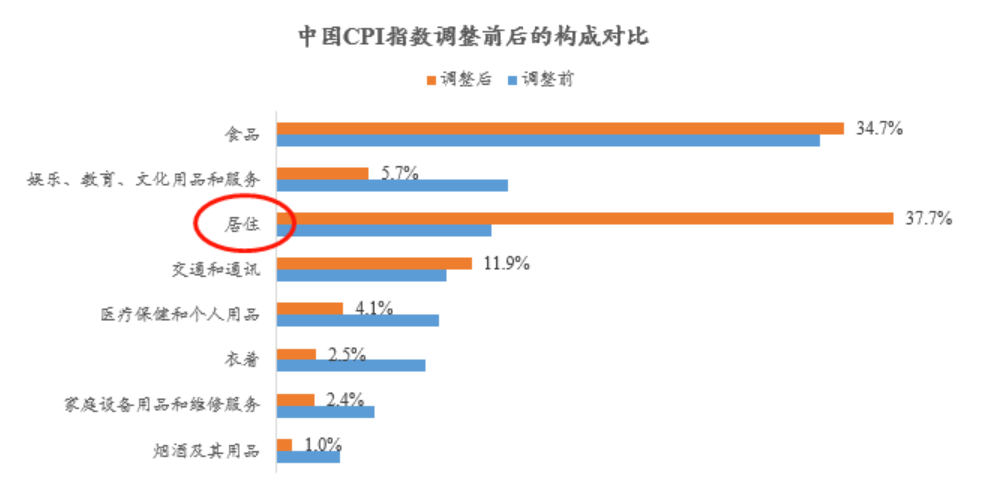
Comparing the composition and weight of the CPI between China and the United States, the impact of the problem is self-evident. Why do people feel that housing prices are soaring, but CPI has always been stable? Why does a fluctuation in pork prices often have a greater impact on CPI? This is closely related to the structure of China's CPI.
In China's CPI statistical calibre, food is the largest category, accounting for 33.2%, while housing accounts for only 13.2%. Since houses are considered investment products rather than consumer goods, the main inclusion in the housing calibre is rent. Comparing the composition of the US CPI, the housing category occupies 42.1% of the CPI.
04
The differences in the composition of CPI between China and the United States are naturally influenced by the economic development stage and industrial structure. However, if we roughly follow the composition proportions of the more mature economic model of CPI in the United States, simulating the restoration of China's CPI, the housing category would reach the highest proportion at 37.7%, slightly higher than the food category at 34.7%. Together, these two categories would account for over 70% of China's CPI composition.
If we consider the unincorporated increase in investment real estate in the consumer price index, pork and eggs may not be the primary culprits in the CPI index.
Source: Harvest Capital simulation calculation
As Professor Wang Depai said, "real estate is the main battlefield for inflation in China."
Real estate-driven growth can be considered a choice made under specific historical stages for economic growth. However, the situation has undergone tremendous changes, and the growth advantages formed in the comfort zone due to path dependence are likely to be counterproductive to this development model.
According to the People's Bank of China, starting from 1996, the leverage ratio of the household sector in China has been continuously soaring, rising from around 18% in 2008 to 56% in 2019. In the first half of 2020, the People's Bank of China's statistics showed that the total debt balance of the household sector in China was RMB 58.9 trillion, with a household debt ratio of nearly 59%. The per capita debt of Chinese residents reached a new high at RMB 40,000.
Many middle-aged people, burdened with mortgages, may seem to have a net worth of millions or billions but still find it challenging to make ends meet. This has created significant crowding out effects on the consumption willingness and liquidity of household funds. The seemingly robust middle class in Chinese society consists mainly of pseudo-middle class and soft-stratum individuals, and the liquidity in their hands is precarious. Some banks even say that, in reality, one-third of Chinese families are already substantively bankrupt.
Furthermore, while the main entities in the real estate market have been grabbing profits, relying on policy advantages during specific periods, and using a set of housing to demolish the wealth accumulated by generations of Chinese families, they have also built a high-debt wall, successfully shifting leverage from the government and corporate sectors to residents.
Once economic growth returns to a healthier structure, the massive funds released after the fall in house prices are likely to be absorbed by the domestic consumption market. The prices of daily consumer goods for residents would be pushed up as a result. Coupled with the slowdown in urbanization, declining income levels, demographic reversal, high debt burden of real estate companies, and other economic downturn expectations, the Chinese economy is likely to fall into a stagflation stage of economic stagnation and inflation.
Just thinking about it gives me chills.
Moreover, the impact of the high-debt development philosophy on the national intellectual level is even more profound.
With the bursting of the P2P bubble and the increasing number of bad debts for the more indifferent younger generation and the astonishing growth of consumer loans, are the younger generations truly riding the waves in this era of great winds? Countless moonlight clans, young people kidnapped by mortgages, car loans, and consumer loans are everywhere. In the stock market, are there more aunties or young people firmly tied up?
Currently, there is a lot of foam in asset prices, yet we continue to encourage young people to take on debt, debt, and more debt. False prosperity allows false rich people to feel good about themselves but conceals the real iceberg beneath the surface. When the real storm comes, they may realize that they don't even have a sturdy paddle in their hands, and the so-called course is nothing more than drifting with the tide.
Seeing this clearly, we realize that everyone is Truman, spending their lives floating in the false illusions created by others.
In the long run, the tremendous implicit damage to the Chinese economy is extremely frightening, as the Gini coefficient continues to rise but ordinary people remain unaware. Once it reaches the point of no return, no cycle can be initiated, and the gears rust.
At this point, the debate between preserving housing prices and maintaining the exchange rate becomes even more clear. Since selling the developed areas of Beijing, Shanghai, Guangzhou, and Shenzhen could buy half of the United States, does this mean that selling these lands could really buy half of America? Everyone knows that this is impossible. The most straightforward reason is that the renminbi exchange rate will not be stably pegged to the US dollar, and Americans do not have so many dollars to allow us to buy half of their country.
The contradiction between high housing prices and a stable renminbi exchange rate is like an overstretched bow that seems to be on the verge of breaking in the next second.
In 2014, Russia abandoned the exchange rate to preserve housing prices, resulting in an increase in import and export dependency. After experiencing a period of economic prosperity with a show of strength and empty talk, Russia's exchange rate saw a substantial depreciation.
The inflation accumulated in the hidden layers of economic development over the past forty years has become the towering tower of nominal wealth today. Those who watch the skyscrapers rising ultimately do not want to see them collapse.
Therefore, between asset price bubbles and a stable renminbi exchange rate, we must make corresponding choices, constructing a healthy and stable relationship among exchange rates, interest rates, and prices in an impossible triangle. During this process, we must continuously strengthen the possibility of RMB internationalization, bringing about sustained and healthy cyclical growth for the Chinese economy.
Then, our great nation's dream is within reach.
Related information